Controlled Acidity Gradients Enable CO₂ Reduction to Formic Acid (Not Formate) by Molecular Electrocatalysts
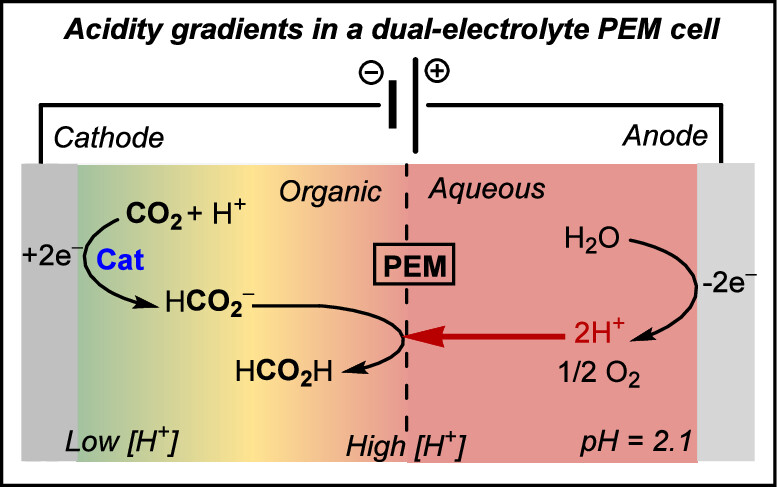
Neutral or basic conditions are commonly required for the selective electrochemical reduction of CO₂, leading to the accumulation of carbonate salts and the generation of formate rather than formic acid. A generalizable strategy for obtaining formic acid (not formate) in the electroreduction of CO₂ with molecular catalysts is introduced, based on controlling acidity gradients using a dual-electrolyte cell with a proton-exchange membrane. This approach uses anodic water oxidation as the source of protons and electrons for CO₂ reduction to formic acid, while mitigating H₂ evolution near the cathode and avoiding carbonate formation. Mechanistic studies, including systems modeling, provide insight into the origin of the formic acid selectivity and guide the broader implementation of this strategy in molecular electrocatalysis for CO₂ utilization.
Fernández, S.; Fernandez, P.; Arnoff, A. I.; Scholer, E. A.; Montgomery, C. L.; Dempsey, J. L.; Mallouk, T. E.; Lopez, R.; Miller, A. J. M. Controlled Acidity Gradients Enable CO₂ Reduction to Formic Acid (Not Formate) by Molecular Electrocatalysts. ACS Central Science 2026. DOI: 10.1021/acscentsci.6c00571