The role of transition metal formyl intermediates in the reduction of CO and CO₂
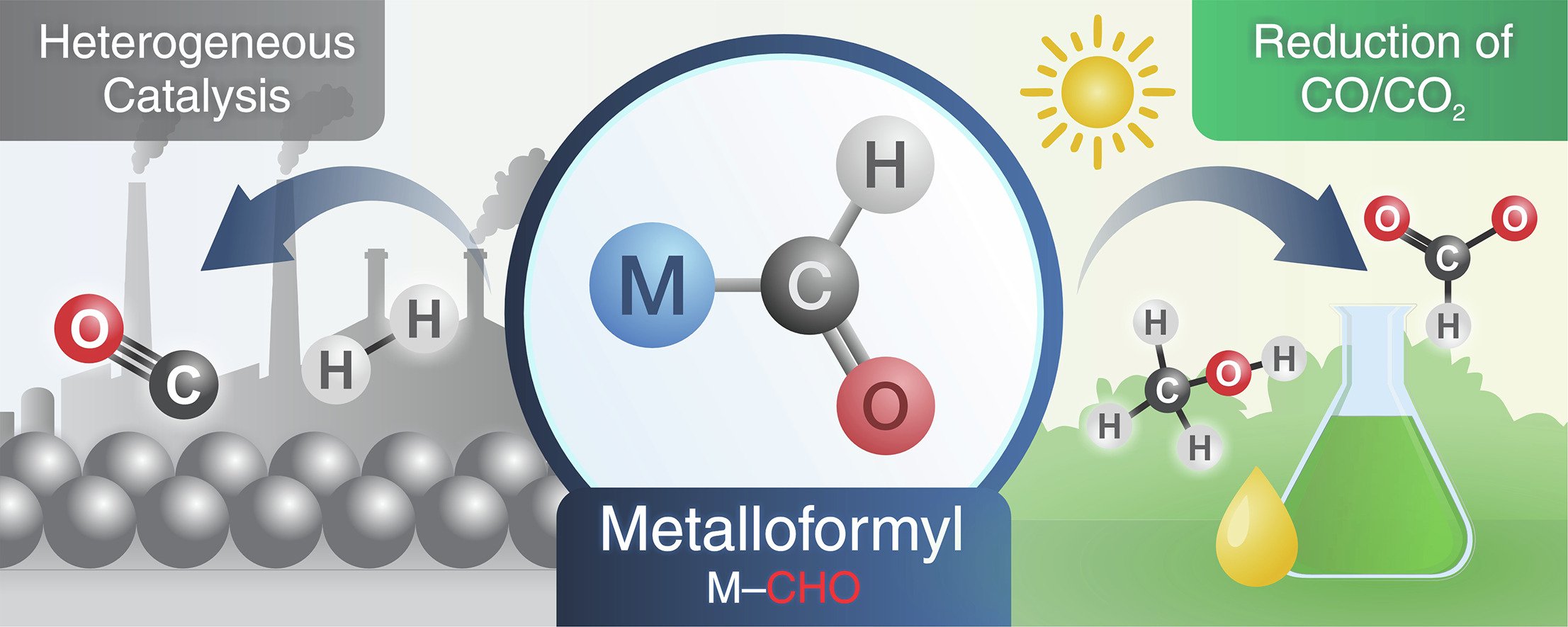
Transition-metal formyl (metalloformyl) complexes occupy a central position in the activation of small molecules, particularly in the reduction of carbon monoxide (CO) and carbon dioxide (CO₂). This review examines five decades of progress in the synthesis of metalloformyl complexes and investigations into their structure and reactivity. The bonding in the M–CHO unit is best described as a resonance hybrid between a classical σ-bound formyl ligand and an oxycarbene-like electronic structure, which governs their distinctive spectroscopic signatures and versatile reactivity. Established synthetic routes are summarized, including pathways involving hydride addition and CO insertion, alongside a discussion of the thermodynamic and kinetic factors that control formyl stability. Decomposition pathways and Lewis-acid stabilization strategies are analyzed as key design principles for extending metalloformyl lifetimes under catalytic conditions. Particular attention is given to hydride transfer processes and the role of metalloformyl intermediates as both reactive substrates and hydride sources in reduction chemistry. Finally, emerging catalytic strategies that exploit metalloformyl intermediates in CO₂ and CO reduction are evaluated, highlighting how control of hydricity, redox potential, and secondary-sphere interactions enables selective CH bond formation under comparatively mild conditions. Collectively, these studies establish metalloformyl complexes as mechanistically informative and functionally relevant intermediates that bridge fundamental organometallic chemistry with modern approaches to small-molecule activation.
(1) Müller, A. V.; Desai, S. P.; Concepcion, J. J. The role of transition metal formyl intermediates in the reduction of CO and CO2. Coordination Chemistry Reviews 2026, 567, 218271. DOI: https://doi.org/10.1016/j.ccr.2026.218271