Chemically Separable Ruthenium Hydride Isomers with Distinct Hydride Transfer Properties
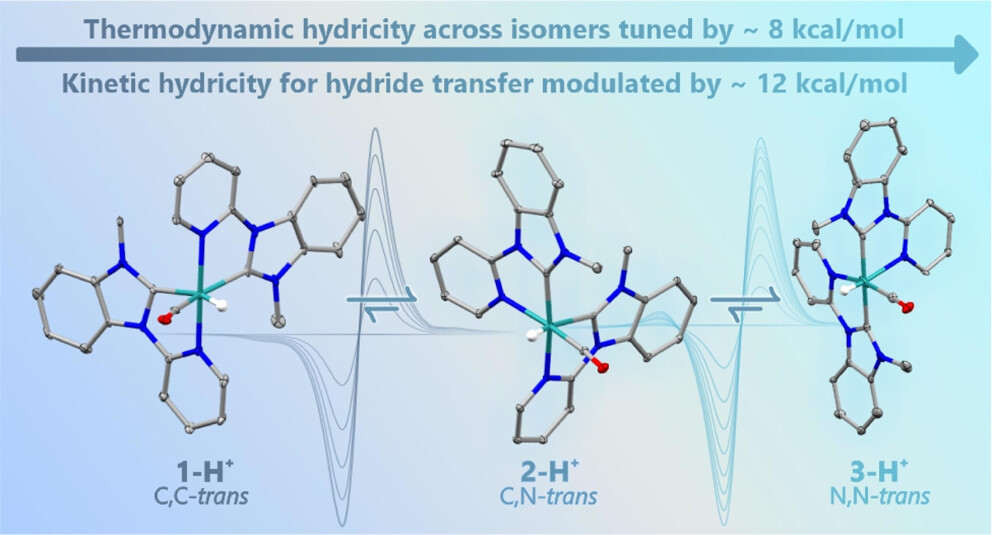
Transition metal hydrides are key intermediates in biological and industrial catalysis, where control over hydride donor ability (hydricity) is essential for optimizing reactivity. Herein, we report a series of isomeric ruthenium hydrides in which the ligand trans to the ruthenium hydride bond–either an N-heterocyclic carbene or pyridine–modulates the thermodynamic hydricity by up to 8 kcal mol⁻¹. These hydrides exhibited distinct reactivity toward CO₂ and various organic hydride acceptors, enabling detailed kinetic and mechanistic analysis. Stopped-flow experiments, isotopic labeling, and computational studies supported an outer-sphere hydride transfer mechanism. Linear free energy relationships (LFERs) and Marcus relationships were utilized to correlate the changes in thermodynamics and kinetics, revealing that ligands with strong trans effects and trans influence can disrupt conventional scaling relationships, which can be a powerful strategy for promoting new reactivity paradigms in hydride transfer reactions.
Desai, S. P.; Müller, A. V.; Cappuccino, C.; Ertem, M. Z.; Concepcion, J. J. Chemically Separable Ruthenium Hydride Isomers with Distinct Hydride Transfer Properties. J. Am. Chem. Soc. 2026. DOI: 10.1021/jacs.5c22137