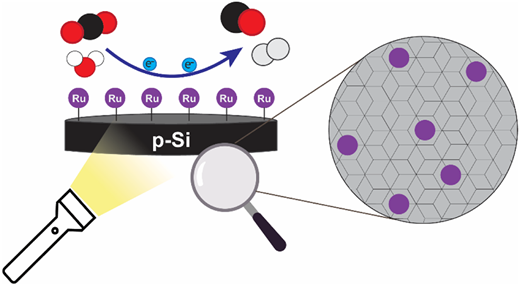
Hybrid photoelectrodes comprised of a molecular catalyst immobilized to a semiconducting substrate are promising architectures for achieving artificial photosynthesis to store photon energy as a chemical fuel. Despite being based on known homogeneous catalysts, these hybrid photoelectrodes often suffer from poor selectivity, and there has been little investigation into the causes of this underperformance compared to traditional catalysts. In this work, we covalently immobilized the CO₂ reduction catalyst [Ru(tpy-4′(C₆H₄-C₂H₃))(Mebim-py)(L)]²⁺ (tpy-4′-(C₆H₄-C₂H₃) = 4′-(C₆H₄-p-C₂H₃)-2,2′:6′,2″-terpyridine, Mebim-py = 1-methylbenzimidazol-2-ylidene-3-(2′-pyridine), L = NCCH₃) to p-Si via sonochemical hydrosilylation to achieve 1% surface coverage. The resulting hybrid p-Si–Ru/hex photoelectrode produced CO with an average Faradaic efficiency of 30%, which was lower than that of the same catalyst in solution. Time-resolved infrared spectroscopic analysis of the hybrid photoelectrodes characterized free carrier recombination kinetics, indicative of defects at the Si–catalyst interface arising from their surface treatment. These surface states are hypothesized to act as charge recombination centers and to mediate proton reduction, siphoning electron equivalents away from the immobilized CO2 reduction catalyst. These competing mechanisms at the p-Si|catalyst interface have implications for the selectivity and efficiency of the hybrid photoelectrode and underscore the importance of preparing a well-passivated photoelectrode for efficient solar fuel production.
Bein, G. P.; Dickenson, J. C.; Holliday, G. A.; Powers, R. E.; Stewart, M. A.; Vecchi, P.; Tereniak, S. J.; Meyer, G. J.; Sampaio, R. N.; Dempsey, J. L. Photon-Assisted CO2 Reduction to CO by a Molecular Ruthenium Catalyst Immobilized on a Silicon Photoelectrode. Artificial Photosynthesis 2026. DOI: 10.1021/aps.6c00008