Nuclear–Electronic Orbital General Rate Theory: Predicting Hydrogen Kinetic Isotope Effects in the Deep Tunneling Regime
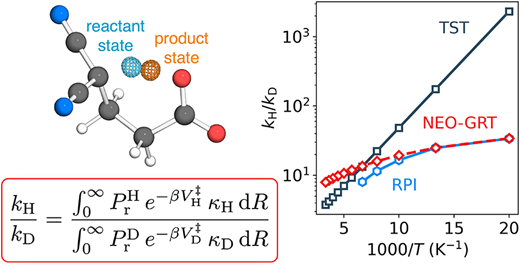
Hydrogen transfer is a critical component of many chemical and biological processes. The ratio of rate constants for hydrogen and deuterium transfer defines the H/D kinetic isotope effect (KIE), which is a powerful tool for elucidating hydrogen transfer mechanisms. Interpretation of experimental H/D KIEs relies on accurate and affordable computational methods. However, due to their light mass, hydrogen and deuterium can undergo tunneling, which is challenging to describe in multidimensional molecular systems. Herein, we introduce the nuclear–electronic orbital general rate theory (NEO-GRT), which enables the efficient prediction of H/D KIEs based on full-dimensional molecular quantum chemistry calculations. The NEO-GRT approach describes the hydrogen transfer rate constant with a general expression that spans the vibrationally adiabatic and nonadiabatic hydrogen tunneling regimes. The input quantities are computed using NEO density functional theory, which treats the transferring hydrogen or deuterium nucleus quantum mechanically on the same level as the electrons. We investigate two intramolecular proton transfer reactions in organic molecules at temperatures down to 50 K to evaluate the performance of NEO-GRT by comparison to transition state theory and ring-polymer instanton theory. The KIEs computed with NEO-GRT agree with those calculated using ring-polymer instanton theory for the full-dimensional molecular systems at the same level of electronic structure theory. This agreement indicates that NEO-GRT captures the deep hydrogen tunneling effects, in contrast to transition state theory, which neglects such effects. Given its relatively low computational cost, NEO-GRT is a promising approach for predicting H/D KIEs in large organic and organometallic systems.
Paenurk, E.; Yoo, J. M.; Hammes-Schiffer, S. Nuclear–Electronic Orbital General Rate Theory: Predicting Hydrogen Kinetic Isotope Effects in the Deep Tunneling Regime. Journal of Chemical Theory and Computation 2026. https://doi.org/10.1021/acs.jctc.6c01175