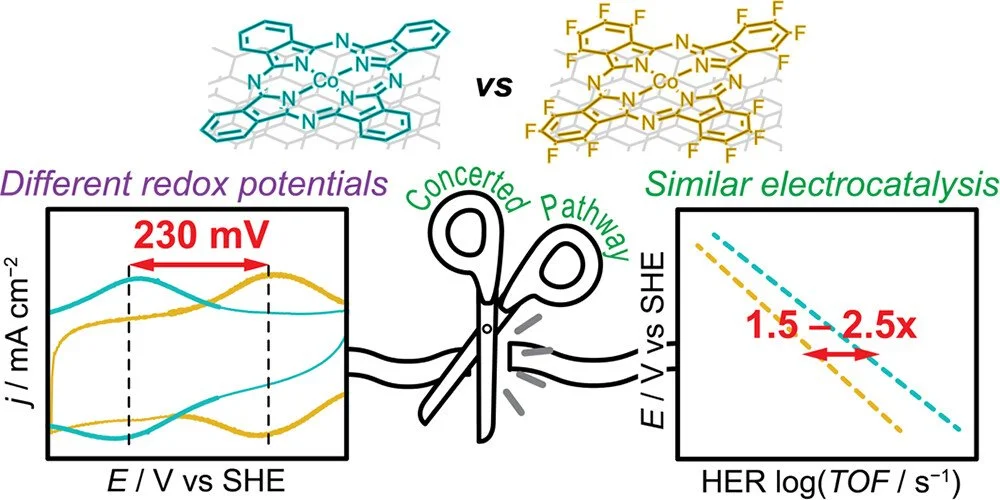
Molecularly modified electrodes (MMEs) are potent electrocatalysts, but few principles exist for their rational design. Electrocatalysis by soluble molecules depends strongly on substituents that tune the catalyst redox potential (E1/2), but it is unclear if this parameter similarly impacts MME catalysis. Herein, we employ the hydrogen evolution reaction (HER) as a test case for comparing carbon-adsorbed cobalt phthalocyanine (CoPc/C) and cobalt hexadecafluoro-phthalocyanine (CoFPc/C). By correlating HER activity and voltammetric data to total Co surface concentration across a wide range of catalyst loadings, we find that only 5–25% of adsorbed Co sites contribute to the Co(II/I) redox wave and that this subpopulation poorly correlates with catalytic activity. Instead, in the low-loading limit, catalytic activity correlates linearly with the majority Co(II/I)-silent Co population, revealing per-site turnover frequency (TOF) values for HER. Despite a 230 mV difference in Co(II/I) redox potentials, CoPc/C and CoFPc/C display TOF values differing by less than a factor of 3 when compared over a wide potential range. Mechanistic studies point to an inner-sphere concerted proton–electron transfer step as rate-determining, suggesting that the Co–H bond dissociation free energy (BDFE) rather than the Co(II/I) E1/2 is thermodynamically relevant. Computational studies indicate that the fluoro-substituents lead to compensatory changes in Co(II/I) E1/2 and Co(I) basicity, leaving the Co–H BDFE largely unchanged between CoPc and CoFPc and thereby manifesting in similar catalytic rates. These results highlight the limited effect of E1/2-tuning on MME catalytic activity and motivate the development of methods to directly alter active site–substrate BDFE.
Mannava, V.; Smith, L. E.; Gardner, J. G.; Hammes-Schiffer, S.; Surendranath, Y. Concerted proton-electron transfer minimizes substituent effects on adsorbed phthalocyanine electrocatalysis, J. Am. Chem. Soc., 2026, 148 (7), 6939-6950. https://doi.org/10.1021/jacs.5c16528