Syngas Production at Si Hybrid Photoelectrodes Modified with Re(I) and Mn(I) Tricarbonyl Phenanthroline Complexes Containing Reactive Aryl Azide Groups
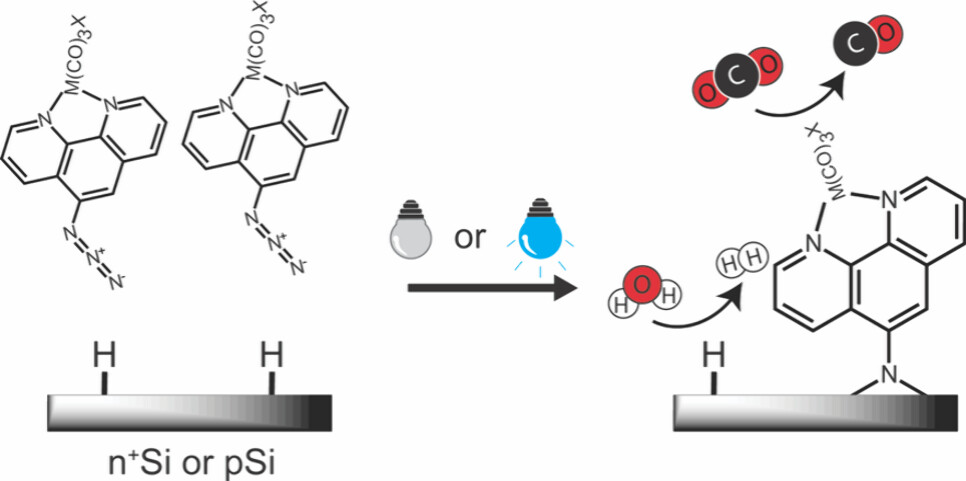
We installed molecular CO₂ reduction (CO₂R) catalysts directly onto Si (photo)electrodes. The highly reactive M(5-azido-1,10-phenanthroline)(CO)₃X (where M = Mn or Re, X = Br or Cl) complexes readily bubbled when dissolved in polar organic solvents, in both the presence and absence of an ultraviolet light source. When placed on hydrogen-terminated Si (H-Si) and native silicon oxide (SiOx), similar amounts of the complex were attached to the surface under illumination (367 nm, 50–200 mW/cm²) or in the dark. Surprisingly, these films revealed submonolayer coverages instead of the multilayered structures we expected. DFT analyses support monolayer formation, showing that the triplet-state nitrene of the complex is more energetically favorable than the singlet state. Using controlled-potential electrolysis experiments, we showed that Re- and Mn-containing films on pSi photoelectrodes generated small amounts of CO when exposed to 1 atm of CO₂ and 1 sun illumination. These amounts of CO were an order of magnitude greater than control surfaces, producing 5.59 × 10⁻⁷ mol CO/h for Re(az-phen) and 7.83 × 10⁻⁷ mol CO/h for Mn(az-phen) films. Much of the charge passed at the pSi electrodes was consumed by the competing hydrogen evolution reaction, which we attribute to the low molecular coverage and the presence of native oxide on the electrode surface after attachment. This work demonstrates the feasibility of reacting azide-containing ligands with Si surfaces. Still, it highlights the need for alternative ligand structures and reaction conditions to form multilayer films.
Orr, A. D.; Robinson, T.; Harvey, A. K.; Alameh, R.; Bonfiglio, A.; McCormick, C.; Wheeler, J. P.; Powers, R. E.; Atkin, J. M.; Cahoon, J. F.; et al. Syngas Production at Si Hybrid Photoelectrodes Modified with Re(I) and Mn(I) Tricarbonyl Phenanthroline Complexes Containing Reactive Aryl Azide Groups. ACS Appl. Mater. Interfaces 2026. https://doi.org/10.1021/acsami.6c02207