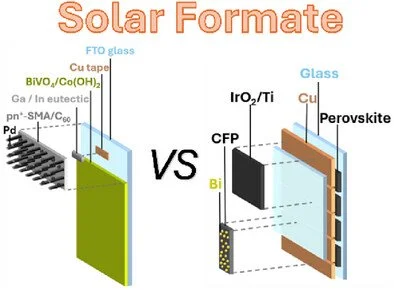
Sunlight-powered artificial leaves for the production of formate from CO₂ are an attractive route to solar fuels, yet existing solar formate devices remain low in performance, and their architecture and material choices are underexplored. Herein, we report the fabrication of two distinct fully integrated, self-standing solar formate device architectures and elucidate the underlying design principles and material selection strategies. The first architecture integrates a Si photocathode with a BiVO₄ photoanode and utilizes a highly active Pd catalyst for CO₂ reduction. It represents the first artificial leaf device comprising two photoelectrodes (excluding photovoltaic [PV]-biased electrodes) for effective formate production under single-beam illumination. The second architecture employs a dark cathode and a dark anode driven by a 4-junction perovskite solar cell and uses a highly stable Bi catalyst for CO₂ reduction. This device delivers a record-high formate production rate of 174 µmol h⁻¹ with a remarkable solar-to-formate energy efficiency of 2% among all artificial leaf devices reported to date. These results demonstrate the feasibility and outline the design principles of both PV-free and PV-assisted device architectures in solar fuel production.
Yu, K.; Shang, B.; Sun, Q.; Gao, Y.; Ren, L.; Schaefer, S.; Yang, J.; Decavoli, C.; Brudvig, G. W.; Wang, H. Two Artificial Leaf Architectures for Solar Formate Production From CO(2) and H(2)O. Angew Chem Int Ed Engl 2026, e2703193. DOI: 10.1002/anie.2703193 From NLM Publisher. https://doi.org/10.1002/anie.2703193