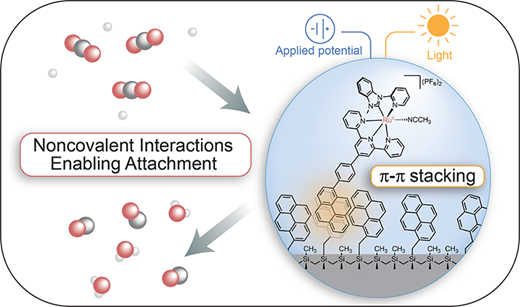
A ruthenium-based CO₂ reduction catalyst immobilized on a Si photocathode through noncovalent π–π interactions is active for the photochemical conversion of CO₂ to CO, with 34% ± 20% Faradaic efficiency with current densities of j = –(0.3 ± 0.1) mA cm⁻² at –1.9 V vs Fc⁺/⁰ in an acetonitrile/water electrolyte solution under 1 sun illumination. Si photocathodes were functionalized with pyrene (p-Si–Py) using a Grignard methodology. A previously reported CO₂ reduction catalyst, [Ru(tpy)(Mebim-py)(NCCH₃)][PF₆]₂ (tpy = 2,2′:6′,2″-terpyridine, Mebim-py = 1-methylbenzimidazol-2-ylidene-3-(2′-pyridine)) was modified to include a pyrene moiety in the terpyridine backbone, enabling π–π stacking of the catalyst onto the Si surface to achieve a surface coverage of (1.85 ± 0.28) x 10⁻¹² mol cm⁻² (ca. 2% to 5% of a monolayer) as quantified via inductively coupled plasma mass spectroscopy (ICP-MS). A 420 mV photovoltage (Vₚₕ) was quantified for the p-Si–Py photocathode. Measurements of charge carrier recombination kinetics through time-resolved infrared spectroscopy indicate that surface attachment of pyrene moieties introduces defects at the Si interface, even without the presence of the catalyst. These defects provide competing kinetic pathways for photogenerated carriers, hypothesized to influence the selectivity of the hybrid photoelectrode, an important implication for future designs of hybrid photoelectrodes.
Powers, R. E.; Jordan, A. M.; Assaf, E. A.; Holliday, G. A.; Jia, X.; Travis, B. D.; Tereniak, S. J.; Dickenson, J. C.; Vecchi, P.; Dones Lassalle, C. Y.; et al. Photoelectrochemical CO2 Reduction to CO by a Molecular Catalyst Attached to Pyrene-Terminated Silicon through Noncovalent Interactions. ACS Appl. Mater. Interfaces 2026. DOI: 10.1021/acsami.6c12581