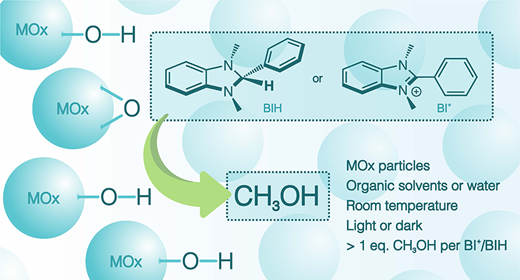
Sacrificial reagents are widely employed in energy conversion research, particularly for the light-driven catalytic reduction of CO₂, CO, and water to generate fuels that can be stored and utilized at a later time. Ideally, these reagents donate electrons and/or protons to a catalyst without otherwise interfering in the fuel forming reactions. This allows researchers to isolate and optimize the reduction reaction of interest without the need to integrate what is oftentimes a more complex catalytic oxidation reaction. In practice, however, sacrificial donors often participate in undesired side reactions that can lead to mistakes in data interpretation. A classic example is found in triethanolamine-type electron donors, which have been known since the early 1980s to undergo reaction pathways that generate a second reducing equivalent, thereby artificially doubling reported quantum yields. While the detailed mechanism for the generation of the second reducing equivalent was unveiled mechanistically only recently, the early knowledge that such reactivity occurred was helpful to the research community and helped avoid confusion concerning reaction yields. It is therefore important to identify the non-ideal behavior of sacrificial reagents particularly when they are widely utilized by the research community seeking to advance the field of solar fuels.
Kuchta III, J. J.; Müller, A. V.; Concepcion, J. J.; Meyer, G. J. Implications for CO₂ Reduction: Methanol Formation by Reaction of Benzimidazole Hydrides with Inorganic Oxide Materials. ACS Energy Letters 2026. DOI: 10.1021/acsenergylett.6c02466