
Hot-Carrier Injection and Millisecond Charge Separation from a Robust Heteroleptic Iron(II) Chromophore Immobilized on TiO₂
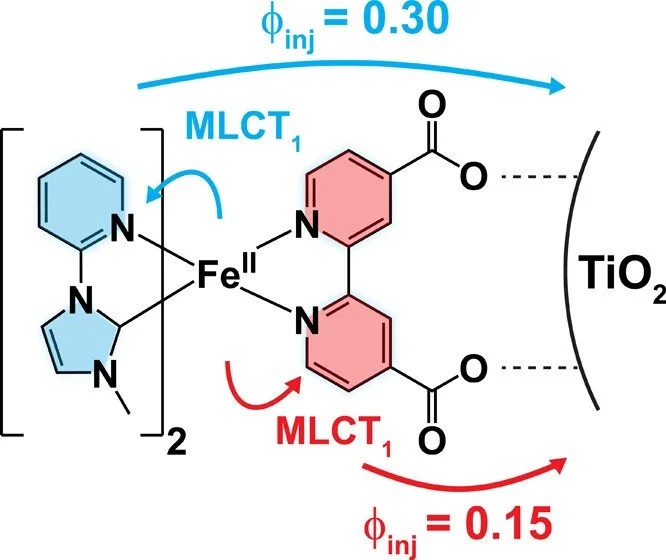
The synthesis, spectroscopic characterization, computational analysis, and photoelectrochemical behavior of a new iron-based chromophore, [(Cpy)₂Fe(deeb)](PF₆)₂ (Fe(Cpy)₂(deeb)), where Cpy is 1-methyl-3-(2-pyridyl)imidazole and deeb is 4,4’-(CO₂CH₂CH₃)2-2,2’-bipyridine, is reported. Electrochemically reversible waves assigned to a metal-centered Eo(FeIII/II) = +0.48 and a ligand-centered Eo(Fe2+/+) = −1.47 V vs Fc+/0 reduction were evident in cyclic voltammetry measurements. The combination of a strong σ-donor and a π-acceptor lowered the energy of the metal-to-ligand charge-transfer (MLCT) excited state relative to the metal-centered state. Two MLCT transitions appear in the visible region at 424 and 580 nm. TDDFT calculations revealed that the lower-energy band was well formulated as Fe(II)→deeb, and the higher-energy transition was charge transfer to both the deeb and Cpy ligands. Resonance Raman spectroscopy supports these findings showing enhanced deeb vibrational modes with 532 nm excitation, both deeb and Cpy modes with 473 nm excitation, and exclusively Cpy with 405 nm excitation. Ultrafast spectroscopy reveals a short-lived (∼2 ps) MLCT excited state and a longer-lived (∼20 ps) metal-centered state. Efficient methods to deprotect the ester groups and anchor the complex to mesoporous TiO2 (anatase) thin films in high surface coverages, Fe(Cpy)₂(dcb)|TiO₂ σ = 3 × 10⁻⁸ mol/cm2, were established. Pulsed light excitation of Fe(Cpy)₂(dcb)|TiO₂ resulted in rapid excited state injection (kinj > 108 s–1) and formation of a charge-separated state, FeIII(Cpy)₂(dcb)|TiO₂(e), which persists on the millisecond time scale before returning cleanly to the ground state with second-order kinetics. Injection yields measured 50 ns after light excitation were found to double from Φ = 0.15 with green (532 nm) light to 0.30 with blue (457 nm) light excitation. Incident photon-to-current efficiency (% IPCE) measurements as a function of excitation wavelength in a 0.5 M LiI/I₂/CH₃CN electrolyte provide clear evidence for band-selective “hot carrier” injection from the remote Cpy-localized excited state. Collectively, the spectroscopic and photoelectrochemical data indicate that a semiconductor can intercept hot electrons from iron chromophores even when the excited-state dipole is oriented away from the surface-anchoring ligand.
Whittemore, T.; Schmalle, M.; Ryndin, E.; Spitler, M.; Brohmer, E. H. P.; Rau, S.; Zedler, L.; Danilov, E. O.; Castellano, F. N.; Kupfer, S.; Meyer, G.; Sorsche, D. Hot-Carrier Injection and Millisecond Charge Separation from a Robust Heteroleptic Iron(II) Chromophore Immobilized on TiO2. J. Am. Chem. Soc. 2026. https://doi.org/10.1021/jacs.5c22325