Finite-element-based simulations of electrodes for CO2 cascade reduction reactions
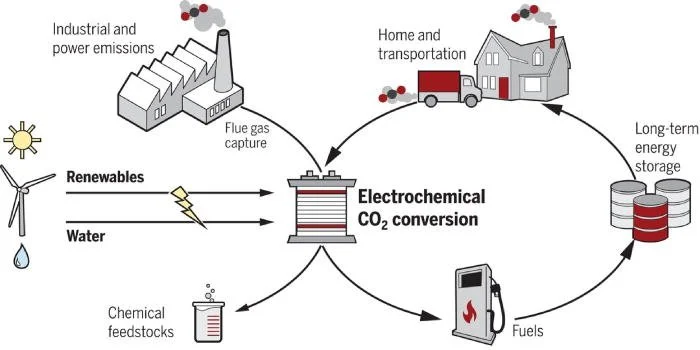
The multielectron reduction of CO2 to liquid fuels could be a path to scalable energy storage, but reaching this goal requires major advances in catalysis and systems engineering. Cascade catalysis, which couples sequential reactions without isolating intermediates, has emerged as a promising route to enhance selectivity and efficiency in CO2 reduction (CO2R). In this review, we examine how finite-element-based simulations of continuum model [finite element method (FEM)] approaches are being used to analyze and guide CO2R cascade systems. We first outline the fundamentals of cascade catalysis and recent advances in catalytic materials (metallic, molecular, and hybrid architectures). We then focus on FEM developments at the electrode and device scales, emphasizing how these models capture transport phenomena, local microenvironments, and geometry-dependent effects. To clarify design principles, we present case studies of cascade electrodes organized in systems without and with integrated semiconductors. We further emphasize the integration of FEM with multiscale frameworks (density functional theory, molecular dynamics, kinetic Monte Carlo) and its role in bridging atomic-level insights with device-level performance. Finally, we identify current limitations and future prospects, including improved boundary conditions, coupling with operando experiments, and machine learning-accelerated model development. Together, these insights provide design principles for next-generation CO2R cascade systems for efficient solar fuel production.
Garcia-Battle, M.; Fernandez, P.; Parsons, G. N.; Cahoon, J. F.; Lopez, R. Finite-element-based simulations of electrodes for CO2 cascade reduction reactions, 2026, Chem. Phys. Rev., 7, 011314. https://doi.org/10.1063/5.0269752